Sunday, 9 August, 2026
Your VO2max Predicts How Long You'll Live. Here's How to Measure Yours.

VO2max is the strongest single predictor of all-cause mortality that exercise science has produced. It measures how much oxygen your body can use at maximum effort. You can estimate yours this week with a running track and a stopwatch, and the number will tell you more about your next forty years than your body weight does.
Why does VO2max predict mortality better than other fitness metrics?
In 2018, Mandsager and colleagues published a study tracking 122,007 patients over two decades. They measured cardiorespiratory fitness and followed who lived and who didn't.
The findings were stark. People in the bottom 25% of fitness had a mortality risk comparable to smoking. Those in the top 2.3%? 80% lower all-cause mortality.
What makes this study different from most is what they did not find. They found no plateau. No upper limit to benefit, no point where additional fitness stopped paying. The fitter you are, the longer you live, across the entire range they measured.
This study is one of the reasons the app is called the25percent. The single largest drop in mortality risk comes from moving out of that bottom quartile. Everything after that is real but incremental. The first quarter is the cliff.
Most fitness metrics tell you something about performance. This one tells you something about time. That is a different category of information, and it deserves a different level of attention than whatever your scale said this morning.
What happened when I measured mine
Ten weeks into my training program, I did a Wattbike submax test. You ride at progressively harder stages while the bike estimates your oxygen uptake. No lab required, no mask on your face.
My result: 33.84 ml/kg/min.
For men aged 40-49, the 50th percentile among healthy adults sits around 38 ml/kg/min (FRIEND registry, the gold standard for directly measured fitness data). I am below that.
My Garmin confirms it in one word: Poor.
Knowing the number changed how I train. Before the test I had a vague sense that I "should improve my cardio." I've had asthma since birth. I hate cardio. But it is what it is.
After the test I had a concrete target: get above 38, then push toward 45, the 75th percentile for my age group. Peter Attia's longevity framework goes further and argues you should aim for the elite fitness of someone a decade younger. That is a long road from 33.84. But you can't close a gap you haven't measured.
The base-building is working. My power output on the bike improved 6.9 percent in those ten weeks. The number still says I have a long way to go.
How do you test your VO2max without a lab?
Three options, from most controlled to most passive.
Bike submax test. A Wattbike or comparable smart trainer runs you through staged efforts and estimates VO2max from your power output and heart rate response. No maximal effort required. Repeatable. Takes about 15 minutes. If your gym has one, this is the one I would use.
Cooper 12-Minute Run Test. Run as far as you can in 12 minutes on a track or a flat measured route. Then convert:
VO2max = (distance in meters − 504.9) / 44.73
Well validated against lab testing, free, and repeatable. The catch is that it requires genuine maximal effort. Hold back and your number comes out too low, which is worse than not testing at all, because you will train against a target that isn't real.
Wearables. Your watch probably already shows an estimate. Use it for trends. The absolute figure is off, and on Apple Watch it reads several ml/kg/min low. Garmin is more consistent but still off on the actual figure.
Direction matters more than precision here. A watch showing your VO2max climbing month over month is real signal even when the number itself is wrong.
What counts as a good VO2max for your age?
Find your age group. These categories come from the Cooper Institute, the same classification your Garmin uses. Apple Watch uses similar ranges drawn from the FRIEND registry.
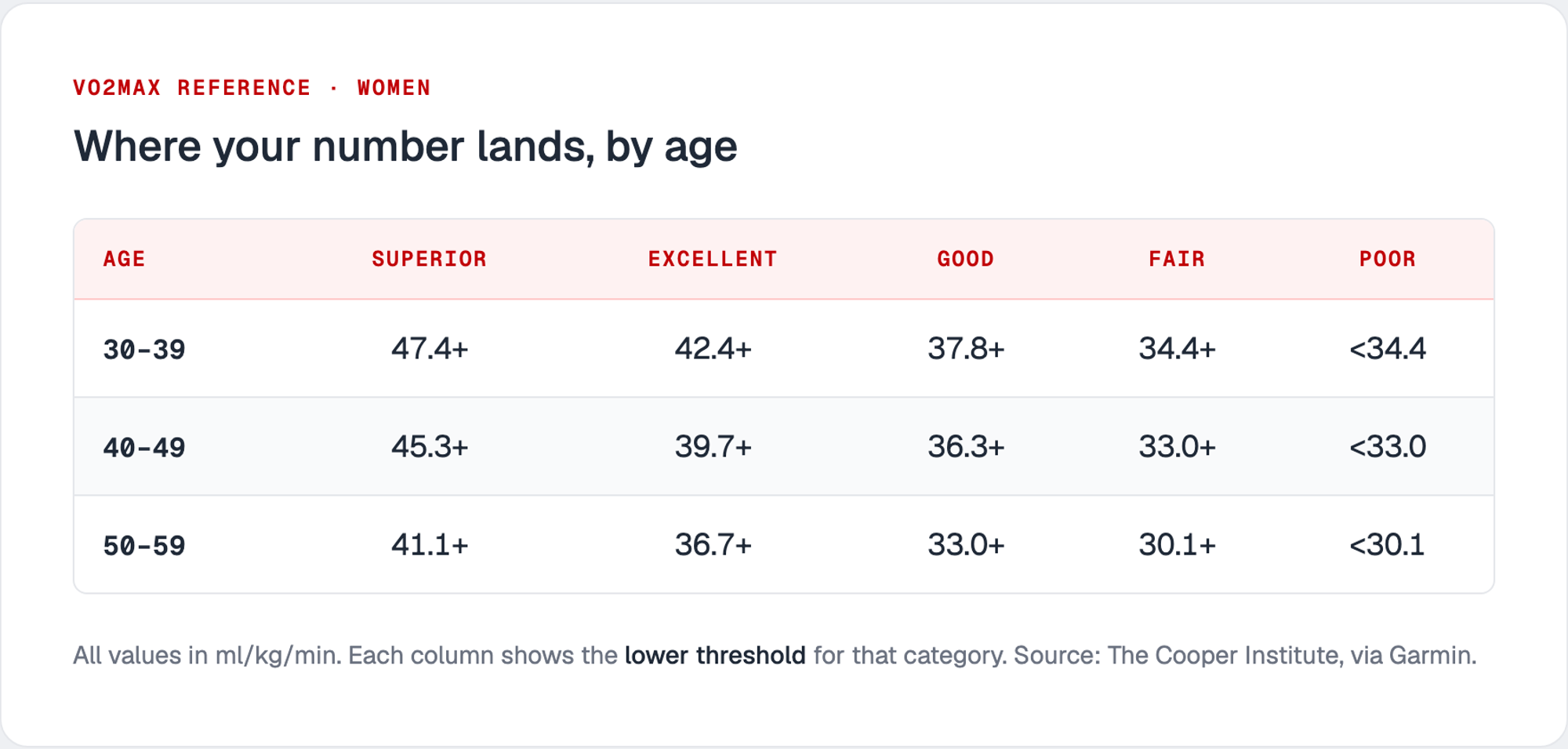
Women, in ml/kg/min:
- Age 30-39: Superior 47.4+, Excellent 42.4+, Good 37.8+, Fair 34.4+, Poor below 34.4
- Age 40-49: Superior 45.3+, Excellent 39.7+, Good 36.3+, Fair 33.0+, Poor below 33.0
- Age 50-59: Superior 41.1+, Excellent 36.7+, Good 33.0+, Fair 30.1+, Poor below 30.1
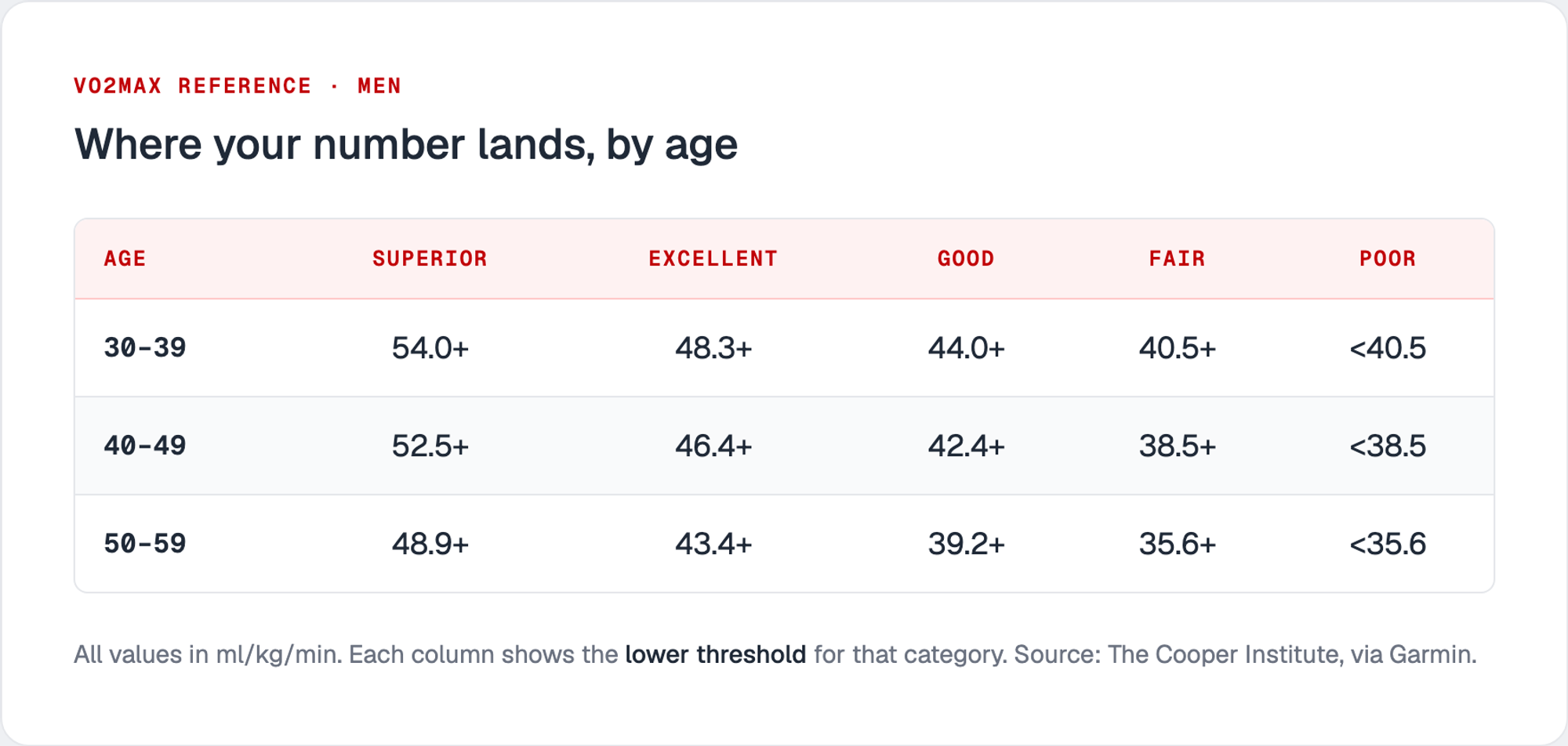
Men, in ml/kg/min:
- Age 30-39: Superior 54.0+, Excellent 48.3+, Good 44.0+, Fair 40.5+, Poor below 40.5
- Age 40-49: Superior 52.5+, Excellent 46.4+, Good 42.4+, Fair 38.5+, Poor below 38.5
- Age 50-59: Superior 48.9+, Excellent 43.4+, Good 39.2+, Fair 35.6+, Poor below 35.6
Source: The Cooper Institute (via Garmin). Values show the lower threshold for each category.
The reference population matters enormously. General-population norms include people who never move, which makes the thresholds flattering. The Cooper Institute table above, and the FRIEND figure I measured myself against, are drawn from health-conscious adults, which is why a number that looks acceptable against a general-population chart can land in "Poor" here. If a table tells you that you are doing fine and your watch disagrees, the table is probably the one grading on a curve.
Don't like where you are? Good. That's the starting point.
Why the number falls, and what training actually does about it
VO2max declines with age in nearly everyone, and the decline is not steady. The Baltimore Longitudinal Study of Aging followed 810 healthy adults aged 21 to 87 for a median of eight years and found the rate accelerates with each decade: 3 to 6 percent per decade in the twenties and thirties, rising past 20 percent per decade from the seventies on (Fleg et al., Circulation, 2005).
So a number that looks acceptable at 40 describes a trajectory rather than a state.
Whether training flattens that trajectory is contested, and the studies point in opposite directions. Masters athletes tracked over eight years lost 5.5 percent per decade against 12 percent in sedentary men (Rogers et al., 1990). In a comparable cohort, the athletes' absolute decline came out at triple that of the sedentary group (Katzel et al., 2001). A third study found the relative rate similar in both groups. The absolute rate was steeper in the trained men, because they fall from a higher number (Pimentel et al., 2003).
Two things reconcile most of that. The athletes start higher, so the same percentage costs them more absolute points. And the studies are not measuring what they appear to measure.
These studies are not measuring training. They are measuring training maintained. In the same cohort where the athletes as a group declined three times faster, the seven men who kept training hard lost 0.28 percent per year. The group that had cut its training back lost 4.6 percent. The variable driving the decline was not age and not athletic history. It was current volume and current intensity.
A reduced training load does not return you to the baseline of someone who never started. It can put you on a steeper path than theirs.
One thing survives without dispute. Training raises your level at every age.
The comfortable version of the story does not survive. The Fleg acceleration held across every level of self-reported leisure activity. And the most conservative synthesis of this literature puts the decline near 10 percent per decade regardless of activity, with high-intensity work shown to halve it in young and middle-aged men, but not demonstrated in older men and not in women (Hawkins and Wiswell, 2003).
Almost every study here used male samples. That is a limit of the evidence and it should be said out loud.
What is a realistic VO2max target?
The temptation after a disappointing result is to set an ambitious target and then find it meaningless three months later. A better approach is staged.
First target: get out of the bottom quartile. That is where the Mandsager data says the largest mortality benefit lives, and for most people in their forties it means clearing the high thirties.
Second target: the 75th percentile for your age group. From the tables above, that is roughly 45 for a man aged 40-49.
Third target, if you want the Attia framing: the elite range for someone a decade younger than you. This is a genuinely demanding goal and it is meant to be.
The number moves faster than the age curve. Eight weeks of Norwegian 4x4 intervals, three sessions per week, took already-trained men from 55.5 to 60.4 ml/kg/min, a gain of 7.2 percent, and beat both shorter intervals and steady-state work in the same trial (Helgerud et al., 2007). Pooled across 28 controlled trials and 723 participants, interval training added around 5.5 ml/kg/min from a starting point of 40.8 (Milanović et al., 2015).
If you suspect you are a non-responder: a meta-analysis of 37 studies found a marked response in every subject once the intervals were long enough (Bacon et al., 2013).
The gains are largest for those starting lowest. That pattern runs across separate studies rather than being measured inside one, so treat it as a direction rather than a coefficient.
None of it happens quietly. The sessions that raise VO2max are the ones you remember afterwards.
What to do with the number
You now have a measurement and a target. What sits between them is a protocol, and it has two halves that do different jobs.
The aerobic base is built at low intensity across a lot of weekly volume. The ceiling is raised in short, genuinely hard intervals. The best studied of these is the Norwegian 4x4: four minutes near maximum effort, three minutes recovery, repeated four times. It is not pleasant. It works.
If intervals are what move the number, why not run three interval sessions a week and skip the low-intensity volume entirely?
On its own terms that reading is correct. Helgerud's 4x4 group trained three times a week and did nothing else, and steady-state work was the weakest arm in that same trial for this specific outcome. If your only goal is a higher number eight weeks from now, intervals are the lever.
The catch is what the trials were built to answer. They ran eight weeks, with supervision and a finish line in sight. None of them tell you what three near-maximal sessions a week look like in month six, or what your knees and your sleep make of it by month twelve. Zone 2 is not in the protocol to raise VO2max, and the evidence above is clear that it is the wrong tool for that job. It is there because it is the volume you can carry every week for years, and because a protocol you abandon in March raises nothing at all.
Cardiovascular fitness is also only one half of the picture. Muscle is a longevity organ in its own right, and the two adaptations are not interchangeable. If you want the full accounting of what a longevity protocol costs in weekly hours, the healthspan gap article does that math. If you are starting from zero, the beginner's guide is the better entry point.
Test yourself this month. Write the number down. Then test again in twelve weeks and find out whether what you are doing is working.
Frequently asked questions
What is a good VO2max for a 40-year-old man?
Against Cooper Institute categories, 38.5 or above is Fair, 42.4 is Good, and 46.4 is Excellent for men aged 40-49. The 50th percentile among healthy adults sits around 38 ml/kg/min. Below that you are in the range where the mortality data starts to matter.
Can I measure VO2max without a lab?
Yes. The Cooper 12-minute run test is well validated against lab testing and requires a measured route, a stopwatch and a maximal twelve minutes. A submax test on a smart bike is more comfortable and repeatable. Both are accurate enough to track change over time.
How accurate is the VO2max on my Apple Watch or Garmin?
Accurate enough for trends. The absolute figure is off, and Apple Watch reads several ml/kg/min low. Garmin is more consistent. Follow the direction of travel and ignore the number itself.
How fast can VO2max improve?
Eight weeks of Norwegian 4x4 intervals at three sessions per week raised VO2max by 7.2 percent in already-trained men (Helgerud et al., 2007). Across 28 controlled trials, interval training added roughly 5.5 ml/kg/min from a 40.8 baseline (Milanović et al., 2015). Gains are largest for those starting lowest.
Should I skip Zone 2 and just do intervals to raise my number?
For an eight-week block aimed only at VO2max, that is close to what the research actually tested: the 4x4 group in Helgerud et al. (2007) trained three times per week and steady-state work was the weakest arm in the same trial. What those studies do not cover is the following year. Zone 2 sits in a longevity protocol as sustainable weekly volume rather than as a VO2max driver, and three near-maximal sessions a week is a load most people cannot hold indefinitely.
Does VO2max always decline with age?
It declines in nearly everyone, and the rate accelerates with each decade rather than staying constant: from 3 to 6 percent per decade in the twenties and thirties to over 20 percent per decade after seventy (Fleg et al., 2005). Training reliably raises the level you decline from. Whether it also flattens the rate is contested, with studies pointing in opposite directions depending on the cohort and on whether the training was maintained.
I'm building the25percent around exactly this problem: a weekly protocol that integrates strength, Zone 2 and VO2max work, so the week is decided before it starts. It launches soon. Get notified.
Alessandro
Sources
Sources
- Mandsager K et al. Association of cardiorespiratory fitness with long-term mortality among adults undergoing exercise treadmill testing. JAMA Netw Open, 2018. PMID 30646252
- Fleg JL et al. Accelerated longitudinal decline of aerobic capacity in healthy older adults. Circulation, 2005. PMID 16043637
- Rogers MA et al. Decline in VO2max with aging in master athletes and sedentary men. J Appl Physiol, 1990. PMID 2361923
- Katzel LI et al. A comparison of longitudinal changes in aerobic fitness in older endurance athletes and sedentary men. J Am Geriatr Soc, 2001. PMID 11844000
- Pimentel AE et al. Greater rate of decline in maximal aerobic capacity with age in endurance-trained than in sedentary men. J Appl Physiol, 2003. PMID 12533496
- Hawkins S, Wiswell R. Rate and mechanism of maximal oxygen consumption decline with aging. Sports Med, 2003. PMID 12974656
- Helgerud J et al. Aerobic high-intensity intervals improve VO2max more than moderate training. Med Sci Sports Exerc, 2007. PMID 17414804
- Milanović Z et al. Effectiveness of HIIT and continuous endurance training for VO2max improvements. Sports Med, 2015. PMID 26243014
- Bacon AP et al. VO2max trainability and high intensity interval training in humans: a meta-analysis. PLoS One, 2013. PMID 24066036
Reference values from The Cooper Institute and the FRIEND registry (Kaminsky et al.).
Medical Disclaimer and Important Notice: The content, programs, and information provided by the25percent are for educational and informational purposes only and are not intended as a substitute for professional medical advice, diagnosis, or treatment from a qualified healthcare provider. Nothing herein should be interpreted as personalized medical guidance. Before beginning any new exercise program, training protocol, or making significant lifestyle changes discussed in our content—particularly if you have pre-existing medical conditions, take medications, are pregnant or nursing, or have cardiovascular, respiratory, or musculoskeletal conditions—you must consult with a licensed physician or qualified healthcare professional. This is not optional; it is essential. The protocols and information we share represent general guidance based on current scientific evidence and research. Individual responses to training, nutrition, and lifestyle interventions vary significantly based on genetics, health status, age, and other factors. We do not guarantee specific results or health outcomes. If you experience chest pain, severe shortness of breath, dizziness, or any other emergency symptoms during or after following our content, seek immediate medical attention by calling emergency services. You assume full responsibility for your decisions and actions related to the use of our content. The25Percent and its creators are not liable for any injury, health complications, adverse effects, or damages resulting from your use or misuse of this information. By accessing our content, you acknowledge and accept these terms.