Sunday, 24 May, 2026
12 Years. The Healthspan Gap Your Lifestyle Is Creating.

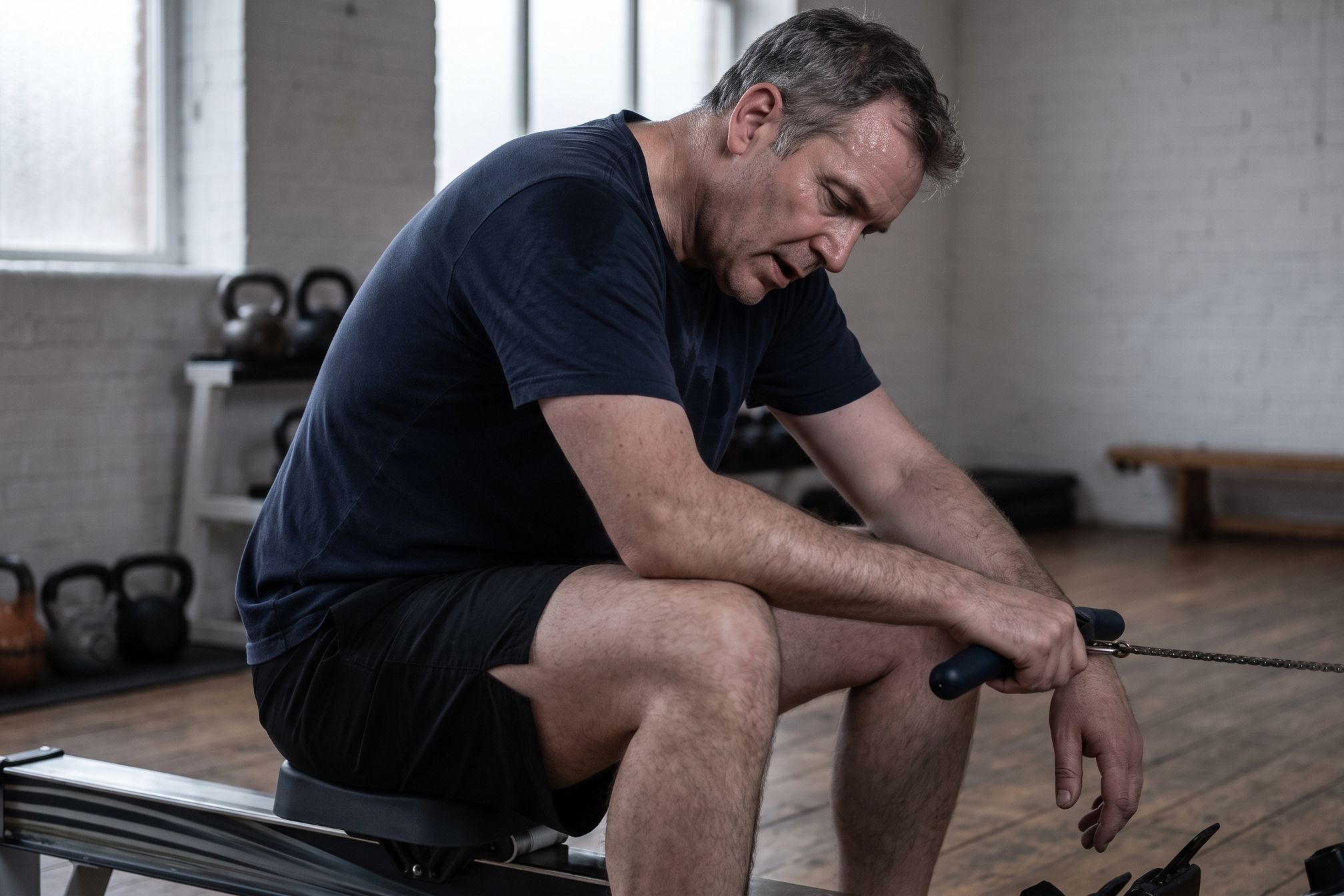
12 Years. The healthspan gap your lifestyle is building.
A breakdown of what it actually costs to close it.
Healthspan is the years you live in good health. Lifespan is the years you live, period. The gap between them is what most people spend dependent, medicated, or limited. In the US, that gap is 12.4 years (Mayo Clinic / JAMA Network Open, 2024). Across Western Europe it runs roughly 9 to 11 years (WHO Global Health Estimates, 2024). Lower than the US, but not by enough to be reassuring. The reasons differ; the answer doesn't.
Closing it is not a matter of motivation, willpower, or finding the right hack. It costs from about 5 hours a week of demanding, integrated training, sustained for decades. This article is the foundational longevity question, answered in hours, kilos, and minutes: why train at all, and what does the answer actually cost? If that sounds like too much, this isn't for you.
What does the 12-year healthspan gap actually look like?
The global gap between how long people live and how long they live in good health grew from 8.5 years in 2000 to 9.6 years in 2019, a 13% increase in less than two decades (Mayo Clinic / JAMA Network Open, 2024). The US sits at the top of the table at 12.4 years.
That is not a statistic. It is a forecast for a generic American: roughly twelve years at the end of life with at least one chronic condition that limits daily function. Climbing stairs becomes a project. Carrying groceries becomes a calculation. The decline accelerates sharply in the final years: terminal decline in physical function runs 6-8x steeper than pre-terminal decline, often starting 1-2 years before death (Stolz et al., 2024, building on the Gill PEP cohort). Imagine this; spending 12 years, dependent on heavy medication, being in constant pain, or even bed bound.
Most longevity content stops here, because the number is dramatic and the audience nods. The gap exists. It is bad. We agree.
The interesting question is the next one: what does it actually take to compress that gap? Not in vibes. In hours per week, kilos on the bar, and minutes at lactate threshold. The literature has answers. They are uncomfortably specific.
What is the actual dose required to close it?
Three pillars, each with a measurable dose. None are optional, and none are forgiving.
Strength. For hypertrophy, the ACSM Position Stand prescribes loads at 70-85% of one-rep max (ACSM, 2009). Modern practice has shifted toward proximity-to-failure over rigid percentages, but the heavier-load principle holds. Borde et al. (2015) and the broader resistance-training meta-analysis literature converge on a clear dose-response: heavier loads (toward 80-85% 1RM) produce greater strength gains in older adults. The trait that prevents you from losing your balance and breaking a hip at 78 lives in that strength capacity. Muscle mass declines meaningfully decade over decade after 30, with roughly 30% lost across a lifetime (Janssen et al., 2000). You do not maintain that with light resistance bands. You maintain it under load.
Zone 2 cardio. Sustained, conversational-pace aerobic work at the upper end of fat oxidation. Structured Zone 2 training drives measurable mitochondrial adaptation in weeks, not months. The ACSM floor is 150 minutes per week of moderate aerobic activity. The longevity literature points higher.
VO2max. The single most predictive cardiorespiratory marker for all-cause mortality. Mandsager and colleagues (2018) found the largest mortality gains at the bottom of the fitness distribution, with a 500% mortality differential between the lowest- and elite-fit groups (adjusted hazard ratio 5.04). To improve VO2max past your mid-30s, you need near-max intervals: Norwegian 4x4s, 30/30s, sprint protocols.
This is the dose. It is not a starter pack.
For more on the strength side specifically, see Strength Training for Longevity: Your Muscles Are a Longevity Organ.
Why does Zone 2 keep getting skipped?
Among people who actually train seriously, readers of Outlive, listeners of Attia, the 5-7h/week crowd, Zone 2 is the universally-skipped pillar. I see it in every protocol I review: the strength is dialed, the high-intensity work is there, and Zone 2 sits in the calendar like a weekly chore that never gets done.
Two reasons. First, it feels too easy. The optimizer brain pattern-matches "easy" to "ineffective" and reroutes the time into another lift session. Second, it takes hours. Not minutes. A real Zone 2 dose is two to three sessions of 45-90 minutes, conversational pace, sustained.
The longevity literature points to a polarized model: a lot of low intensity, a little very high intensity, very little in between. The middle zone is less efficient per hour than dedicated Z2 or Z5 work. Moderately hard, vaguely uncomfortable, the default heart-rate of most people who "do cardio." Hard enough to fatigue you, not hard enough to drive the adaptation either pillar produces on its own.
Skipping Zone 2 is the structural error of the volume-tolerant trainee. He is not under-working. He is mis-allocating.
For the case against monoculture training, see Hybrid Training: The Anti-Monoculture Approach to Longevity.
What does the protocol cost in hours per week?
Here is the weekly load, with a realistic range:
- Strength: 3-4 sessions, 45-60 min each → 2.5-4 h/week
- Zone 2: 2-3 sessions, 45-90 min each → 2-4 h/week
- VO2max (HIIT): 1-2 sessions, 25-40 min each (incl. warm-up) → 0.5-1.5 h/week
Total: from ~5 hours per week. The upper end of each range is where full closure lives; the lower end is the entry point. Not counting mobility, sleep, food prep, or recovery.
For someone already training around 5 hours a week, this is achievable. For the recovering athlete returning from a decade off, this is achievable after a 2-4 week self-paced ramp. Most adults train under two hours a week, if at all. This article doesn't write down to that floor. The dose-response doesn't bend, and pretending it does is what got us a 12-year gap in the first place. If you're at zero hours, the entry point is the Beginner's Guide to Longevity Training, not this protocol.
A few numbers worth sitting with. Elite-athlete cohorts associated with longevity advantages train well above public-health minimums, at the upper end of what humans seem to tolerate without negative return. The ACSM floor of 150 minutes moderate-intensity aerobic plus two strength sessions is the minimum, not the optimum. The minimum-effective dose and the longevity-optimal dose are not the same number.
Recovery and mindfulness are the protocol's fourth pillar, but they aren't priced in hours-per-week. Recovery is part of the dose, not on top of it. Cortisol responders show roughly two years of accelerated cellular aging compared to non-responders (Steptoe et al., 2017). If the training hours come on top of chronic sleep debt and unmanaged stress, the protocol stops paying out.
What does it cost to NOT do this?
Older adults with functional limitations cost the health care system over $24,000 per year on average, with broader societal costs near $27,000 per person (Falck et al., 2022). EU aging-related public spending is projected to rise by 1.2 percentage points of GDP, reaching roughly 25.6% by 2070 (EU Ageing Report, 2024). These are downstream costs. The system absorbs them, but you live them.
The personal math is harder to look at. A 500% mortality differential between low- and elite-fit groups (Mandsager et al., 2018) means that in a peer cohort of ten 70-year-olds, the bottom-fitness men are dying at five times the rate of the top-fitness men. Not in twenty years. Now.
The 12.4-year US gap is not evenly distributed. It clusters in the people who did nothing about it. The people who closed it (who trained the protocol, lifted heavy, did the Z2, kept the VO2max from collapsing) are not in the average. They built themselves out of it.
The cost of skipping is not "I might feel a bit slower at 65." The cost is roughly twelve years of dependency, $17k/year on the back end, and a meaningfully higher chance of being dead before your kids finish their thirties.
Who closes the gap
Two archetypes show up over and over. The 38-year-old who runs five sessions a week and can't tell if his Z2 is doing anything. The 49-year-old who used to row in college, lapsed for a decade, and just got an ApoB result he doesn't like. Both already train seriously, have time and agency, and want the integrated dose. Both close the gap.
If you've been sedentary for years, jumping into 5+ hours of demanding training at week one is how injuries happen. Start somewhere else first. The Beginner's Guide to Longevity Training and the beginner strength program are the right entry points.
If you're looking for 20-minute sessions, three days a week, that will somehow do the job, that reader exists. He'll buy a different app. The dose-response math doesn't bend for him, and pretending it does is dishonest.
The protocol is demanding. The cost of not running it is higher.
FAQ
Q: Is 5+ hours per week realistic for someone with a full-time job and kids?
For most senior knowledge workers, yes, if it's the priority that gets calendar protection. The barrier is rarely time on paper. It is decision fatigue around what to do each session and when. Removing the weekly decision is the lever.
Q: Can I close most of the gap with strength training alone?
No. Strength addresses muscle mass, bone density, and falls risk. It does not move VO2max meaningfully, and VO2max is the strongest cardiorespiratory predictor of all-cause mortality (Mandsager et al., 2018). Strength-only is a partial protocol.
Q: What's the minimum dose that still moves the needle?
The ACSM floor (150 min/week moderate aerobic activity plus two strength sessions) produces measurable benefit over sedentary. It is not the longevity-optimal dose. The gap between minimum and optimum is the gap between "less bad than nothing" and "actually compressing the 12 years."
Q: Do I need to track sets, reps, and weights to make this work?
For the longevity protocol, no. Adherence (did you complete the prescribed sessions this week) predicts outcomes more reliably than load tracking. Most apps over-index on logging because logging is what apps can do. Consistency is what bodies respond to.
Q: What if I'm in my 50s and have been inactive for a decade?
You are likely in the recovering-athlete sub-segment if you trained seriously in your 20s-30s. The protocol works, but ramp into it over 2-4 weeks of self-paced volume building before hitting the full weekly dose. If you have never trained seriously, the dose-response still applies, but you need a longer ramp than this article assumes.
A note on the app
the25percent prescribes the weekly protocol (strength, Zone 2, and VO2max sessions calibrated to your fitness level) and tracks whether you completed it. Binary adherence, not load logging. The protocol is the data. Hard paywall, no free tier, no quick-fix framing. If you want a longevity protocol you don't have to assemble yourself, the waitlist is open.
If you want efficient, time-light, easy-to-stick-to fitness, this isn't the product.
Sources
References
- ACSM (2009). Progression Models in Resistance Training for Healthy Adults. Position Stand. Medicine & Science in Sports & Exercise.
- Borde, R., Hortobágyi, T., & Granacher, U. (2015). Dose-response relationships of resistance training in healthy old adults: a systematic review and meta-analysis. Sports Medicine, 45(12), 1693–1720.
- EU Ageing Report (2024). Economic and budgetary projections for the EU Member States (2022-2070). European Commission.
- Falck, R. S. et al. (2022). International depiction of the cost of functional independence limitations among older adults: a systematic review. BMC Geriatrics, 22, 814.
- Garmany, A. & Terzic, A. (2024). Global Healthspan-Lifespan Gaps Among 183 WHO Member States. JAMA Network Open. (US 12.4 years; global average 9.6 years; +13% since 2000.)
- Gill, T. M. (2014). Disentangling the disabling process: insights from the Precipitating Events Project. The Gerontologist, 54(4), 533–549.
- Janssen, I., Heymsfield, S. B., Wang, Z., & Ross, R. (2000). Skeletal muscle mass and distribution in 468 men and women aged 18-88 yr. Journal of Applied Physiology, 89, 81–88. (Lifetime distribution; per-decade rates from sarcopenia review literature.)
- Mandsager, K. et al. (2018). Association of cardiorespiratory fitness with long-term mortality. JAMA Network Open, 1(6), e183605. (Adjusted hazard ratio 5.04 low vs elite.)
- Steptoe, A. et al. (2017). Cortisol response and accelerated cellular aging. Psychoneuroendocrinology.
- Stolz, E., Mayerl, H., Gill, T. M., et al. (2024). Terminal decline in physical function in older adults. The Journals of Gerontology: Series A, 79(1), glad119.
- WHO Global Health Estimates (2024). Healthy life expectancy (HALE) by region.
Medical Disclaimer and Important Notice: The content, programs, and information provided by the25percent are for educational and informational purposes only and are not intended as a substitute for professional medical advice, diagnosis, or treatment from a qualified healthcare provider. Nothing herein should be interpreted as personalized medical guidance. Before beginning any new exercise program, training protocol, or making significant lifestyle changes discussed in our content—particularly if you have pre-existing medical conditions, take medications, are pregnant or nursing, or have cardiovascular, respiratory, or musculoskeletal conditions—you must consult with a licensed physician or qualified healthcare professional. This is not optional; it is essential. The protocols and information we share represent general guidance based on current scientific evidence and research. Individual responses to training, nutrition, and lifestyle interventions vary significantly based on genetics, health status, age, and other factors. We do not guarantee specific results or health outcomes. If you experience chest pain, severe shortness of breath, dizziness, or any other emergency symptoms during or after following our content, seek immediate medical attention by calling emergency services. You assume full responsibility for your decisions and actions related to the use of our content. The25Percent and its creators are not liable for any injury, health complications, adverse effects, or damages resulting from your use or misuse of this information. By accessing our content, you acknowledge and accept these terms.