Thursday, 30 April, 2026
Lifting for Longevity: The Beginner Strength Program That Actually Works

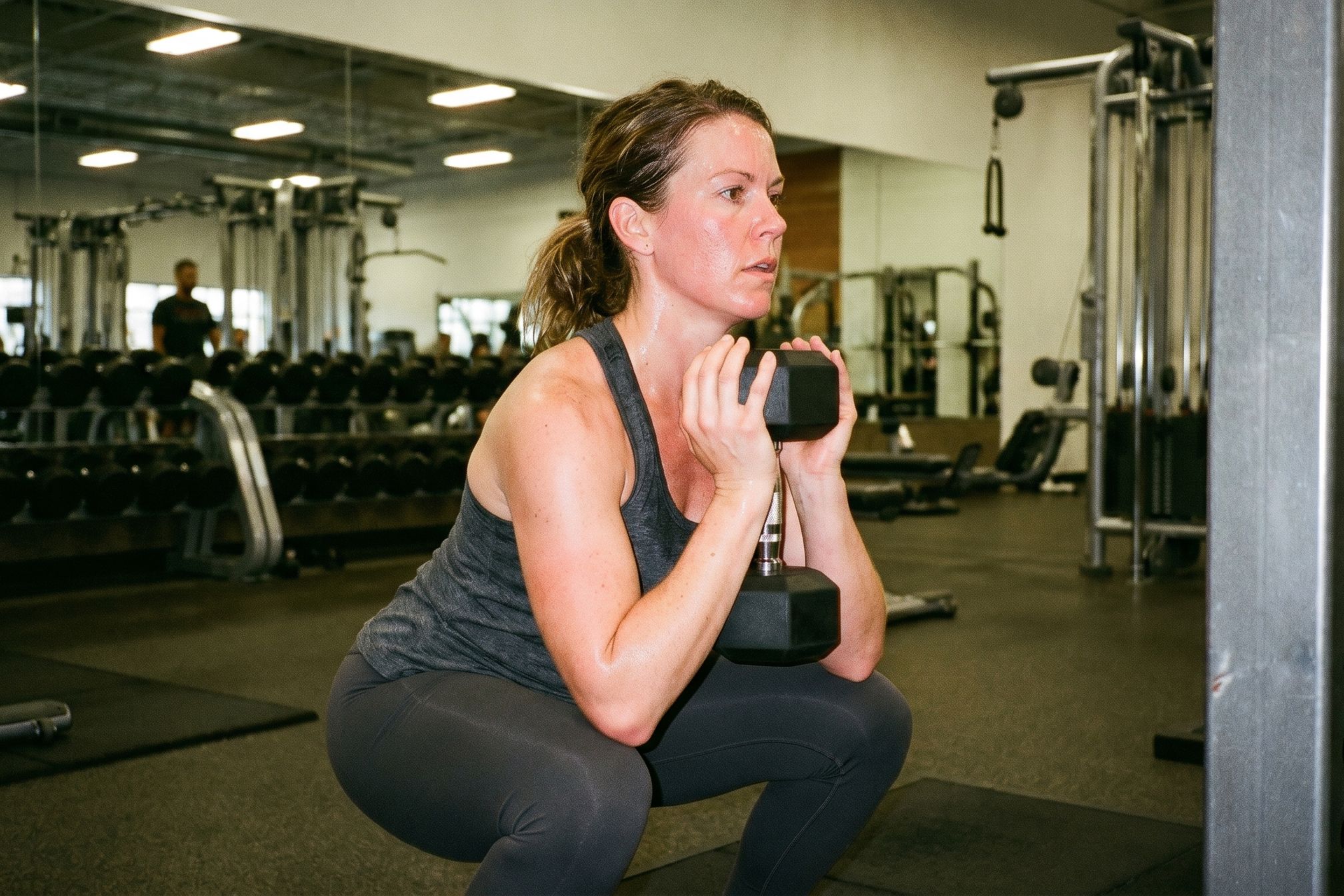
The short answer: Lift twice a week for 30 to 40 minutes. Five exercises: goblet squat, back extension, lat pulldown, incline dumbbell press, and external rotation. Use 7–9 reps for main lifts, 8–12 for accessories. Add a rep each session; when you top the range, add weight and reset. That is the whole program (for the first 8–10 weeks).
Most longevity advice tells you to lift. You probably already agree. The thing usually missing isn’t the science. It’s a plan short enough to start on Monday, without a coach, a 12-week book, or a new pair of shoes. The reasons not to start tend to evaporate once a real plan exists.
If you’ve read the science on strength training and healthspan, the case is settled. Muscle is metabolic insurance. Sarcopenia starts earlier than people think. For a beginner, two short sessions a week move the mortality needle. What’s missing for most readers isn’t another argument. It’s a plan they can run on Monday.
This is that plan. Five exercises, two sessions a week, 30 to 40 minutes per session. Lifting for longevity, written for people who’ve never followed a real program. If you’ve never picked up a weight before, that is the assumption here, not a problem to fix first.
Why is strength training non-negotiable for longevity?
Skeletal muscle is the largest organ system in your body. It handles roughly 80% of insulin-stimulated glucose uptake, secretes signaling molecules that regulate inflammation and brain health, and acts as mechanical insurance against the falls and hospital stays that shorten lives after 65. Calling it “just for movement” misses what it actually does.
The clinical term for age-related muscle loss is sarcopenia, and the strength loss arrives first. Years before mass visibly declines, the nervous system loses the ability to recruit muscle fibers quickly. By the time you notice thinner arms in the mirror, the functional deficit has been accumulating for a decade.
How much strength training do you actually need?
The dose required to push back is smaller than the fitness industry suggests. A 2022 meta-analysis by Momma et al., published in the British Journal of Sports Medicine, found that 30 to 60 minutes per week of resistance training reduced all-cause mortality, with a J-curve that flattens above three hours. Two sessions of 20 to 30 minutes is the absolute floor for the mortality benefit. Three sessions of 45 to 60 minutes is the sweet spot for actually building muscle. The program below sits between the two: two sessions of 30 to 40 minutes, which puts you above the floor and on a real strength-building track without demanding a third weekly session. Most adults are at zero, and the steepest part of the dose-response curve is the move from zero to something.
Combine resistance training with aerobic work and the numbers compound. The same Momma 2022 meta-analysis found that combined resistance plus aerobic activity is associated with roughly 40% lower all-cause mortality versus neither. That is a larger effect size than most pharmaceutical interventions for chronic disease, and it is the reason a serious longevity plan trains both systems instead of picking sides.
For the full case (muscle as endocrine organ, the menopause shift, the “bulky” myth, the honest gaps in the research), see Article 03: Your Muscles Are a Longevity Organ. This article assumes you’ve made peace with the why and want the how.
The 5-exercise program
Full body, twice a week, 30 to 40 minutes per session.
Five exercises: two lower body, two upper body, one stabilization. One pull and one push for the upper body.
Rep range 7–9 for the main lifts, 8–12 for accessories (smaller muscles and isolation exercises).
- Dumbbell/Kettlebell Goblet Squat — 3 sets × 7–9 reps, 90s rest
- Dumbbell 45° Back Extension — 2 sets × 8–12 reps, 120s rest
- Lat Pulldown — 3 sets × 7–9 reps, 120s rest
- 20° Dumbbell Incline Bench Press — 3 sets × 7–9 reps, 120s rest
- Dumbbell External Rotation on One Knee — 2 sets × 8–12 reps, 120s rest
Why these five, in this order:
Goblet Squat. Lower body, knee-dominant. Holding the load at the chest keeps the torso upright and forces the anterior core to brace. It is not a shortcut to a barbell back squat — only a barbell back squat teaches that. What the goblet does is lower the entry barrier: easier to coach, less mental load, less intimidating for someone who has never squatted with weight before. That is enough reason to start here.
45° Back Extension. Posterior chain: glutes, hamstrings, spinal erectors. Most knowledge workers have a posterior chain that hasn’t been challenged since school, and that is the cheapest insurance you can buy against lower-back issues. The Back extension lays the foundation for later heavy hinge dominant exercises like deadlifts etc.
Lat Pulldown. Vertical pull. Scales smoothly across strength levels in a way pull-ups don’t, so you can find your working weight in one session instead of needing months of progression to get to a single bodyweight rep.
Incline Dumbbell Bench Press. Pressing pattern, shoulder-friendlier than a flat barbell bench. Dumbbells let each side work independently, which exposes asymmetries early.
External Rotation on One Knee. Rotator cuff. Looks unimportant. It is the prerequisite that lets you press and pull heavier later without your shoulders complaining.
That is the whole program. No ab finisher, no biceps work, no booty machine. Longevity training for beginners works on focus, not coverage.
How do you pick the right weight?
Give yourself the first two weeks before chasing numbers. Pick weights you can clearly handle. Run all five exercises through their full rep range with deliberately submaximal load. The point of this runway is grooving technique, not stimulus. People who skip it spend the next two months fixing form errors they baked in during week one.
Once the movements feel grooved, find your working weight. The target weight is one where you hit nine reps cleanly in your first set and start to fail around seven reps in your last set. That spread between first and last set isn’t weakness; it’s how the program is designed. Fatigue across sets is the signal that the load is honest.
From there, the progression rule is simple: add one rep per session until you top the range on every set, then add weight and reset. If you rep out all sets without struggle, the weight is too light. If you can’t clear seven reps on set one with clean technique, the weight is too heavy. Adjust on the next session, not mid-set.
What does the progression look like in practice?
Here is what one exercise’s progression looks like over five sessions.
Session 1: Goblet Squat
- 20kg × 9
- 20kg × 8
- 20kg × 7
Session 2: Goblet Squat
- 20kg × 9
- 20kg × 9
- 20kg × 8
Session 3: Goblet Squat
- 20kg × 9
- 20kg × 9
- 20kg × 9
Session 4: Goblet Squat
- 20kg × 9
- 20kg × 9
- 20kg × 10
Session 5: Goblet Squat (weight bumped, range resets)
- 22kg × 9
- 22kg × 8
- 22kg × 7
That is how you get stronger. Same logic for Lat Pulldown and Incline Bench. The Back Extension and External Rotation use the 8–12 range with the same rep-then-load rule.
Can you do this at home with kettlebells or bodyweight?
The program above is written with a gym in mind. The reason is practical, not snobbish: machines and dumbbells make progressive loading easy, the learning curve is low, and leaving the house to train turns out to be the single biggest habit lever for most beginners. The friction of “go to the gym” is lower than the friction of “set up a home session next to your laundry.”
Kettlebells are a valid alternative. A set of three kettlebells (light, medium, heavy) plus a pull-up bar covers most of what you need. The five exercises don’t all map one-for-one. You’ll swap the lat pulldown for negative pull-ups or rows, and the incline bench for a floor press or push-up variant. The structure holds. A kettlebell-and-bodyweight setup that progresses on the same rep-then-load logic as a gym program is what most people actually need.
Bodyweight alone works as a bridge. The progression ceiling is lower for strength work, and once push-ups and squats stop feeling hard, you’ll have to invent harder variations to keep adapting. Fine for the first month if a gym isn’t available. Not where to stay.
Training vs. moving
One distinction worth making: training is not the same as moving, even when both happen in a gym. A body-pump class is movement, closer to cardio than to strength work. Lifting the same weights for the same reps for nine months running is also movement. Neither is bad. Both leave you mostly where you started.
Training has a goal, a structure, and a progression toward that goal. The example I use: someone runs five kilometres once a week, same route, two years running, mostly to clear the head. That is movement, and it is genuinely valuable. Training would mean a goal, say five kilometres under thirty minutes, and a plan to reach it: sprint sessions, longer runs, cadence work.
The same applies to resistance training. The reason this article specifies sets, reps, rest, and a progression rule is that those four together are what separate training from showing up. For a deeper take, Wolfgang Unsöld’s piece on training versus going through the motions is worth the ten minutes.
Common mistakes
Treating rest days as bonus workout days. Recovery is where adaptation happens. A second hard strength session sandwiched between your two main days isn’t ambition; it’s noise that erases the signal. Easy Zone 2 walks, light cycling, or mobility on rest days is fine. That is the aerobic side of the system doing its job. A second high-intensity session isn’t.
Not increasing weights. The program runs on progressive overload. If the same weights stay on the bar for weeks, you are maintaining, not building. Push the load when the reps are clean.
Same plan, all year. A plan is a static prescription: do these exercises, in this rep range, until further notice. A program is a plan that evolves as you do – rep ranges shift, exercises rotate, intensity gets recalibrated. What you have above is your first plan. After roughly 4 to 8 weeks of clean progression, your system has adapted, and that plan needs to become a program. The cue is to change something (rep ranges, exercise selection, set counts), not to bolt a sixth and seventh exercise onto the same template. The plan most people are still running months later is the one their gym coach handed them on day one. That plan was right for day one. It stopped being right around week eight.
What to do next
If you want the longer case for why this matters, read the Article on muscle as a longevity organ. If you want the cardio half of the picture, the Zone 2 work that pairs with this program, start with the beginner’s guide to longevity training.
If you want this program built into a complete weekly longevity protocol, with strength, Zone 2, and VO2max sessions already scheduled and a streak that forgives a missed day, join the the25percent waitlist. It removes the weekly “what should I do” decision so you can stay focused on showing up.
Two sessions a week. Five exercises. Start at the floor. The floor is enough.
FAQ
How often should beginners lift for longevity?
Twice a week is the floor that moves the mortality needle, based on the Momma et al. (2022) dose-response data. Three sessions of 45 to 60 minutes is better for muscle growth, but two well-run sessions beat three skipped ones. Start at two and stay there for at least 8 weeks before adding a third.
How heavy should the weights be?
Heavy enough that you hit nine clean reps on set one and start failing around rep seven on the last set. If all sets feel easy, the weight is too light. If set one breaks form before rep seven, it is too heavy. Adjust on the next session, not mid-set.
Can I do this program at home without a gym?
Yes, with three kettlebells and a pull-up bar. Swap the lat pulldown for assisted pull-ups or rows and the incline bench for a floor press or push-up variant. The structure (two sessions, five movements, rep-then-load progression) stays the same. Bodyweight alone works for the first 4 to 6 weeks, then progression stalls.
How long until I see results?
Strength gains show up in 2 to 4 weeks (mostly neural). Visible muscle change takes 8 to 12 weeks of consistent progression. The metabolic and longevity benefits (better glucose handling, lower resting blood pressure, improved sleep) often arrive before the mirror changes.
Medical Disclaimer and Important Notice: The content, programs, and information provided by the25percent are for educational and informational purposes only and are not intended as a substitute for professional medical advice, diagnosis, or treatment from a qualified healthcare provider. Nothing herein should be interpreted as personalized medical guidance. Before beginning any new exercise program, training protocol, or making significant lifestyle changes discussed in our content—particularly if you have pre-existing medical conditions, take medications, are pregnant or nursing, or have cardiovascular, respiratory, or musculoskeletal conditions—you must consult with a licensed physician or qualified healthcare professional. This is not optional; it is essential. The protocols and information we share represent general guidance based on current scientific evidence and research. Individual responses to training, nutrition, and lifestyle interventions vary significantly based on genetics, health status, age, and other factors. We do not guarantee specific results or health outcomes. If you experience chest pain, severe shortness of breath, dizziness, or any other emergency symptoms during or after following our content, seek immediate medical attention by calling emergency services. You assume full responsibility for your decisions and actions related to the use of our content. The25Percent and its creators are not liable for any injury, health complications, adverse effects, or damages resulting from your use or misuse of this information. By accessing our content, you acknowledge and accept these terms.