Thursday, 18 June, 2026
Why Committed People Quit Training They Believe In

The short version: identity, more than willpower or information, decides who is still training twelve weeks from now. Committed people quit when training never becomes part of who they are.

Whether you are still training twelve weeks from now will be decided by something your training plan cannot touch: whether training has become part of who you are.
That is the fourth permission, the one I left you with last time. It depends almost entirely on who you get to be while you do it.
It took me a decade of my own training to believe that.
Ask people why they fell off and you'll mostly hear one of two reasons. There was no time; they couldn't get even one session into the week. Or it stopped being fun, so they stopped.
Both are honest, and both sit on top of the same thing. "No time" is what training sounds like before it becomes part of who you are; we all find time for what we treat as non-negotiable, and the week bends around identity. Fun has a shelf life. Train because it's fun and you'll last exactly as long as the fun does, which is rarely through a dark February. The reason that holds is who training lets you be.
Why do people who believe the science still stop?
You are not short on information. Maybe you have read Outlive, you have the podcasts, you know what the week is supposed to contain. So knowledge is not the thing standing between you and a consistent twelve weeks.
The research is blunt about this. A 2013 meta-analysis by Rhodes and de Bruijn (N = 3,899) found a 48% intention-behaviour gap for physical activity. Nearly half of the people who fully intend to train at guideline levels don't. Stated intention explains only 18 to 20% of the variance in whether people actually move (Hagger; McEachan). You are the inclined abstainer, the one who means it and still misses the week. It was never an information problem, and more reading won't change that.
What keeps one person training and stops another?
I lifted for years, and for most of them I had a reason: capability. Be able to do a pull-up, a clean deep squat, a deadlift I wasn't embarrassed by, run 5k without falling apart. That reason held right up until I had those things, more or less. Then a question started showing up between sets: I am not a bodybuilder, I don't want to be a powerlifter, so what am I adding weight to the bar for? Progress went shallow, and lifting slowly stopped being something I prioritised.
I went looking for a reason in the movement world: yoga, skill work, the Ido Portal corner of the internet. Portal's case stuck with me, that lifting trains you for a moment that never comes and does less for the brain than learning new skills. It pulled me, but that path demanded more than it gave back.
Then my second meniscus surgery, and a wall of contradictory advice. Two doctors, two physios, four opinions. I couldn't evaluate any of it, and I disliked depending on people I couldn't check. So I went and got certified, first the Strength Coach Certificate at YPSI in Stuttgart, then the Trainer Certificate with Axel Gottlob. I had no real interest in coaching anyone. I wanted to stop being at the mercy of advice I couldn't weigh.
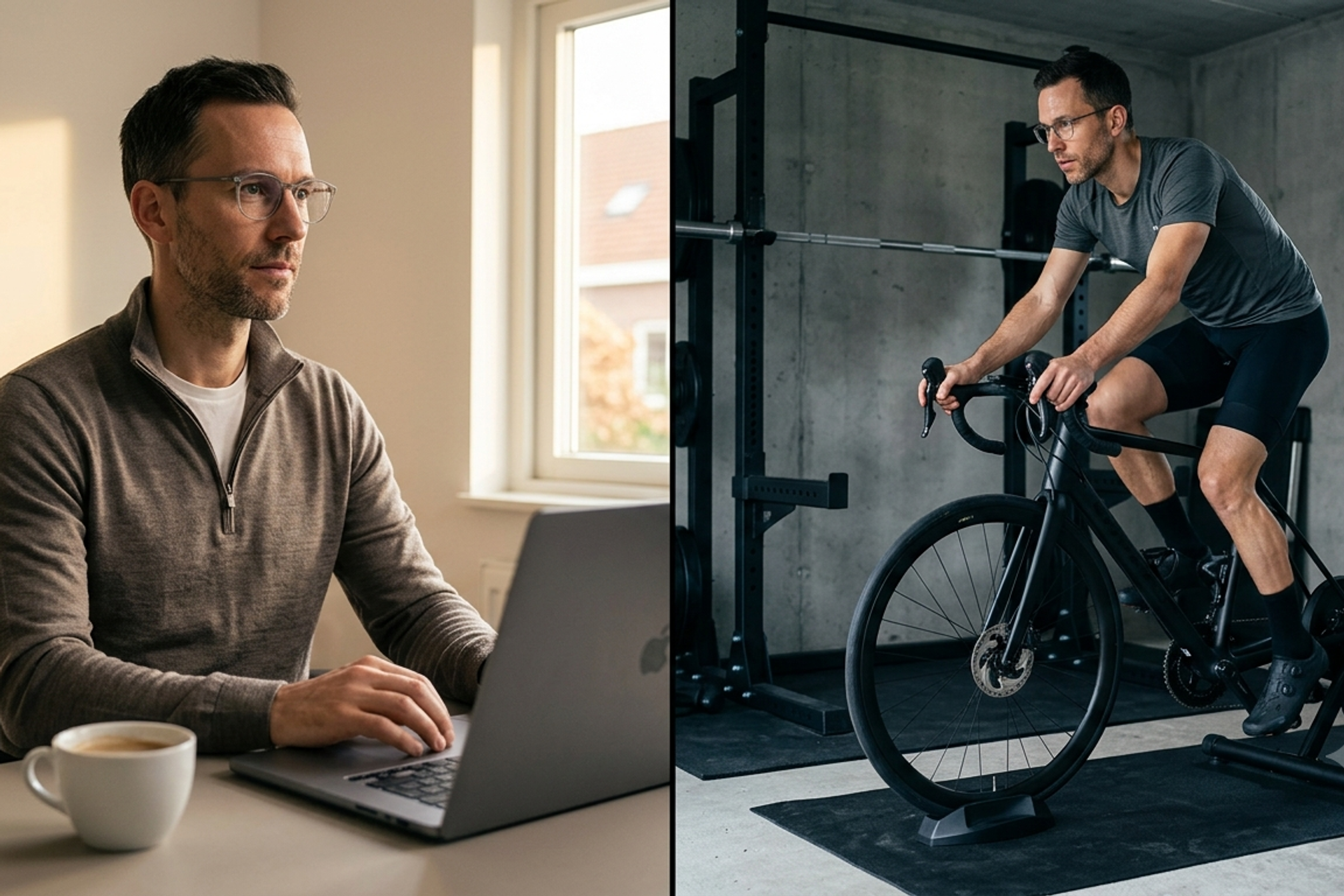
Then I discovered Outlive. Peter Attia took the reason I already had and pushed it across decades. The pull-up I wanted this year became the strength to carry my own life at seventy. Still not a bodybuilder, but now someone who trains so the back half of my life is worth living. That frame did what no program ever did. Now it made sense again to add weight, to track, to progress. It is also why I now own an indoor trainer, despite having no interest in cycling and no bike-nerd bone in my body, and why I willingly grind through Norwegian 4x4 intervals that no one does for fun. The identity pulls behaviours that have zero appeal on their own.
That is the whole mechanism, and the research names it precisely. Oyserman's work on identity-based motivation shows that when an action feels identity-incongruent, difficulty gets read as proof that "this isn't for people like me," and the behaviour gets dropped. When the same action feels congruent, the difficulty becomes evidence it matters. Rhodes' Multi-Process Action Control framework lands on the same finding: training identity is the single strongest correlate of action control.
So do you just decide you are a training person?
This is the trap, and I want to be careful with it. You cannot install the identity by announcing it. Telling yourself "I am an athlete" on Sunday does nothing for Monday, because identity is downstream of evidence, and on Sunday you have none.
The order runs the other way. You do the thing at a size you can actually repeat, the evidence accumulates, and the identity forms around it. The adherence data is stark here: minimum-dose protocols clock 81 to 97% adherence, while standard "complete" programs sit closer to 18% at six months (Iversen; Jukic). The smaller, doable version is the one that survives long enough to become who you are.
You become an athlete by repeating athlete things until they become yours.
Notice that my own turn came through getting more competent, which is exactly the instinct I warned against in Permission 3. The distinction matters. The certifications gave me enough grounding to trust a protocol I didn't design and stop rebuilding the week every Sunday. Self-compassion research (Breines and Chen, 2012) points the same way: giving yourself room produces more effort over time, not less. Permission to do the smaller version is the only version that gets you to week twelve.
Which is the entire product problem I work on now, and it is a hard place to stand. Even the minimum the science supports is already demanding for a normal person. To carry it, you more or less have to become some kind of athlete. That is exactly why identity does the heavy lifting here: a floor that demanding outlasts motivation, and an identity is what keeps a person on it. The work is to engineer enough doable evidence, week after week, that a normal person grows into someone who can meet that floor. How that gets built is its own letter.
So what is the fourth permission?
Permission to train as the person you already are. A reason to lift that a non-bodybuilder can hold on a Tuesday in February, when the fresh-start energy is long gone.
Which identity is your current training week building?
Im building the25percent around exactly this problem: a weekly protocol you track and follow. It launches soon. Get notified
Until next time,
Alessandro
FAQ
Why do I train in waves and never stay consistent?
Because going hard in bursts runs on motivation, and motivation spikes then crashes. The adherence research is blunt: intention explains only 18 to 20% of whether people actually keep training (Hagger; McEachan), and minimum-dose protocols that feel almost too easy hold 81 to 97% adherence versus roughly 18% for ambitious ones. The fix for stop-and-go is a smaller, repeatable dose anchored to identity, not another hard push.
Isn't discipline what keeps people consistent?
Discipline helps on a given day. It does not explain who is still training in three months. Oyserman's identity-based motivation research shows that whether a hard session feels worth it depends on whether training feels identity-congruent. When training fits who you are, the difficulty reads as meaning. When it sits outside your sense of self, the same difficulty becomes a reason to stop, and discipline only partly overrides it.
How long until training feels automatic?
It tracks adherence, not a fixed clock. Minimum-dose protocols hold 81 to 97% adherence, while standard programs hold roughly 18% at six months, because the doable version accumulates the repetitions that build identity. The window is months of repeatable action, not weeks of intense intent.
Does giving myself permission to do less just make me lazy?
The evidence says the opposite. Breines and Chen (2012) found self-compassion increases motivation to improve rather than reducing it. Permission here means doing the smaller version that survives contact with a real week, not abandoning the standard. It is the version that reaches week twelve, which is where results live.
Sources
- Rhodes & de Bruijn (2013), British Journal of Health Psychology 18(2), 296–309 — the 48% intention-behaviour gap.
- Hagger et al. (2002); McEachan et al. (2011) — intention explains roughly 18–20% of physical-activity variance.
- Oyserman, Fryberg & Yoder (2007), Journal of Personality and Social Psychology 93(6), 1011–1027 — identity-based motivation.
- Rhodes (2017, 2021) — Multi-Process Action Control (M-PAC) framework.
- Iversen et al. (2023), PMC11127831 — resistance exercise minimal dose strategies.
- Jukic et al. (2025, preprint) — predictors of long-term resistance adherence in beginners.
- Breines & Chen (2012), Personality and Social Psychology Bulletin 38(9), 1133–1143 — self-compassion increases improvement motivation.
Medical Disclaimer and Important Notice: The content, programs, and information provided by the25percent are for educational and informational purposes only and are not intended as a substitute for professional medical advice, diagnosis, or treatment from a qualified healthcare provider. Nothing herein should be interpreted as personalized medical guidance. Before beginning any new exercise program, training protocol, or making significant lifestyle changes discussed in our content—particularly if you have pre-existing medical conditions, take medications, are pregnant or nursing, or have cardiovascular, respiratory, or musculoskeletal conditions—you must consult with a licensed physician or qualified healthcare professional. This is not optional; it is essential. The protocols and information we share represent general guidance based on current scientific evidence and research. Individual responses to training, nutrition, and lifestyle interventions vary significantly based on genetics, health status, age, and other factors. We do not guarantee specific results or health outcomes. If you experience chest pain, severe shortness of breath, dizziness, or any other emergency symptoms during or after following our content, seek immediate medical attention by calling emergency services. You assume full responsibility for your decisions and actions related to the use of our content. The25Percent and its creators are not liable for any injury, health complications, adverse effects, or damages resulting from your use or misuse of this information. By accessing our content, you acknowledge and accept these terms.